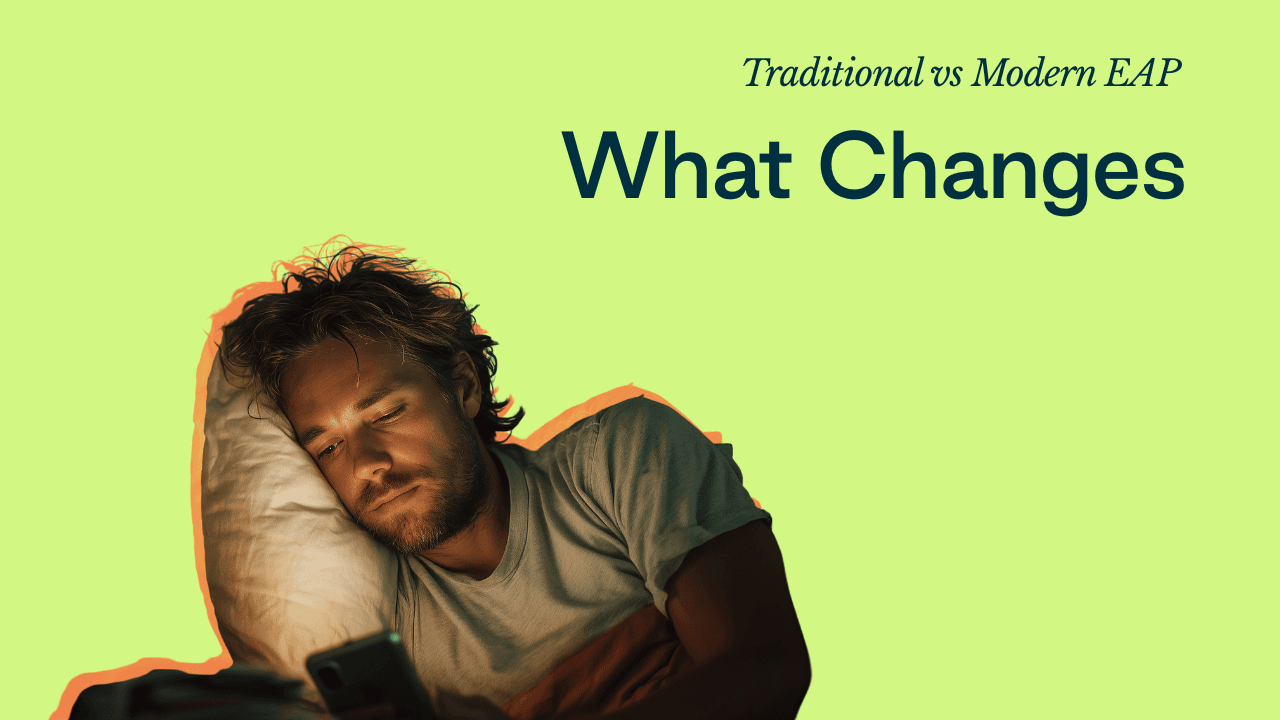
It’s 3 am. Someone on your team is awake, half-thinking about work and half-trying not to. It’s not a crisis, not yet, but it’s starting to spill into everything.
They remember the Employee Assistance Programme exists, and what it asks of them: call a number, explain themselves to a stranger, and wait.
So they close the tab. They tell themselves they’ll deal with it tomorrow.
That moment is why traditional EAPs often underperform. They were built for a hotline era. Modern virtual-first EAPs are built for the moment people actually reach for help: privately, quickly, and in small first steps.
And it’s not a niche problem; work-related stress remains a major driver of ill health in Great Britain.
The game-changer isn’t video calls; it’s removing friction, enabling earlier intervention, and giving employers planning-grade insight without compromising trust.
Traditional EAPs weren’t Built for the Moment of Need
In the UK, a traditional EAP typically means a phone number, an intake process, and a route to short-term counselling. Most traditional EAPs also bundle practical support (like legal and financial guidance), but those additions rarely change the thing that drives uptake: how easy it feels to start.
It’s a recognised support benefit, contractually familiar, and widely adopted. But it rests on an assumption that doesn’t always hold: that when someone needs support, they’ll pick up the phone and explain what’s going on.
In reality, the moment people consider reaching out is rarely calm or scheduled. It’s private, time-pressed, and emotionally loaded. A phone call can add friction at exactly the wrong moment, not because people don’t want help, but because starting feels harder than postponing.
So they delay. By the time they access support, it’s often later in the escalation cycle. Performance has already dipped, absence is more likely, and trust is more fragile.
What “Virtual-First” Changes, and What it Doesn’t
A modern EAP isn’t automatically better because it’s digital. “Virtual” can still mean the same experience in disguise: a new interface that leads to a phone call, a waiting period, and uncertainty.
Virtual-first becomes meaningfully different when it changes three practical things.
It lowers the threshold for starting. Instead of “call and explain,” the first action is smaller and clearer: start here, choose what you need, take one step now.
It reduces time and uncertainty. Programmes that perform well tend to close the gap between recognising a need and reaching a meaningful first step.
Not every issue requires immediate counselling, but most benefit from a fast, credible first interaction, especially when someone is already stretched.It makes trust easier to understand. Most EAPs are confidential. Employees don’t always believe it. Virtual-first models have an advantage when privacy boundaries are communicated clearly at the point of use: what stays private, what employers can and can’t see, and what triggers safeguarding pathways.
In the UK, “GDPR compliant” is rarely reassurance on its own, employees want to understand, in plain language, how their information is handled (see ICO guidance for employers).
The Goal isn’t More Utilisation, it’s Earlier Utilization
The more useful question isn’t “how much is it used?” but “when is it used?” relative to the escalation curve.
Late-stage use sounds like: “I can’t cope anymore” or “I’m already off sick.” Early use sounds like: “I want to deal with this before it gets bigger” or “I need a safe space to think.”
Virtual-first models tend to shift that curve when they’re designed around real behaviour, making the first step easy, fast, and credible.
The Question that Actually Matters When Buying
Not: Is it virtual? Not: Does it have an app?
Ask this: When someone is struggling, is it easier for them to start, or easier for them to postpone?
If postponement is easier, you’ll see the same pattern regardless of the platform: low early engagement, higher costs down the line.
When comparing providers, look past feature lists. A few questions that tend to reveal how an EAP will actually perform:
What happens in the first 10 minutes — a clear guided start, or a generic contact page?
How quickly does someone reach a meaningful response (not just “sessions available”)?
How is confidentiality explained to employees, in plain language, at the point of use?
What does the employer receive — utilisation data alone, or aggregated insight that still protects individual privacy?
They tell you what the employee experience will genuinely feel like.
Where Kyan Health Fits
Think back to 2:07 am. That person didn’t need a counsellor yet. They needed a low-stakes first step that didn’t require explaining themselves to a stranger or waiting days for a callback.
That’s the gap Kyan is built around, not the crisis end of the curve, but the quiet, private moment traditional EAPs often lose.
The experience starts with an AI companion, KAI, that helps someone articulate what they’re dealing with and points them toward a relevant next step, quickly and privately.
Guided triage then routes them to the right kind of support for their situation, rather than a single generic entry point. For lower-level issues, the things people don’t feel “serious enough” to book a session over, self-guided tools provide a credible path without waiting for availability.
For employers, aggregated reporting surfaces patterns, rising demand, recurring themes, and re-engagement rates, without any visibility into individual use. Enough signal to act earlier. Not enough to make employees hesitate before starting.
Ready to see how it works in practice?
Not sure where your current EAP is falling short? Talk to our teamand have a practical conversation about what better early intervention could look like for your workforce.
Frequently Asked Questions
What’s the difference between traditional and virtual-first EAP?
Traditional EAPs typically require employees to call a hotline and wait for an appointment. Virtual-first EAPs provide immediate access through digital tools, guided triage, and self-service options, reducing the time between recognising a need and getting support.Are virtual EAPs confidential?
Yes. Reputable virtual EAPs maintain the same confidentiality standards as traditional programmes. The difference is how clearly privacy is communicated at the point of use. Employers receive only aggregated, anonymised data, never individual usage details.How to choose an EAP provider?
Focus on the employee experience at the first step: How easy is it to start? How quickly do they reach meaningful support? How clearly is confidentiality explained? Compare what employers receive in reporting — look for aggregated insight that informs workforce planning, not just utilisation numbers. For a comprehensive guide, see our article on how to choose an EAP provider in 2026.