If you’re responsible for employee well-being, you’ve probably been asked about your Employee Assistance Programme (EAP) utilisation rate in a budget review or leadership meeting. It’s the metric everyone wants to know: Are people actually using this programme?
But here’s where most conversations get stuck: on the number itself. Is 6% good? Should we aim for 12%? What does 8% even mean?
The truth is, EAP utilization rate is a starting point, not a verdict. It tells you who’s walking through the door, but understanding what your number means and whether it’s pointing to a problem requires context.
In the following sections, we’ll clarify what EAP utilization rate measures, how to calculate it, what benchmarks reveal, and how to interpret your numbers.

What Is EAP Utilization Rate?
EAP utilization rate is the percentage of eligible employees who access your Employee Assistance programme at least once during a defined period, typically 12 months.
It’s one of the most commonly tracked metrics for workplace mental health programmes and serves as a baseline indicator of whether employees are engaging with available support. The Formula
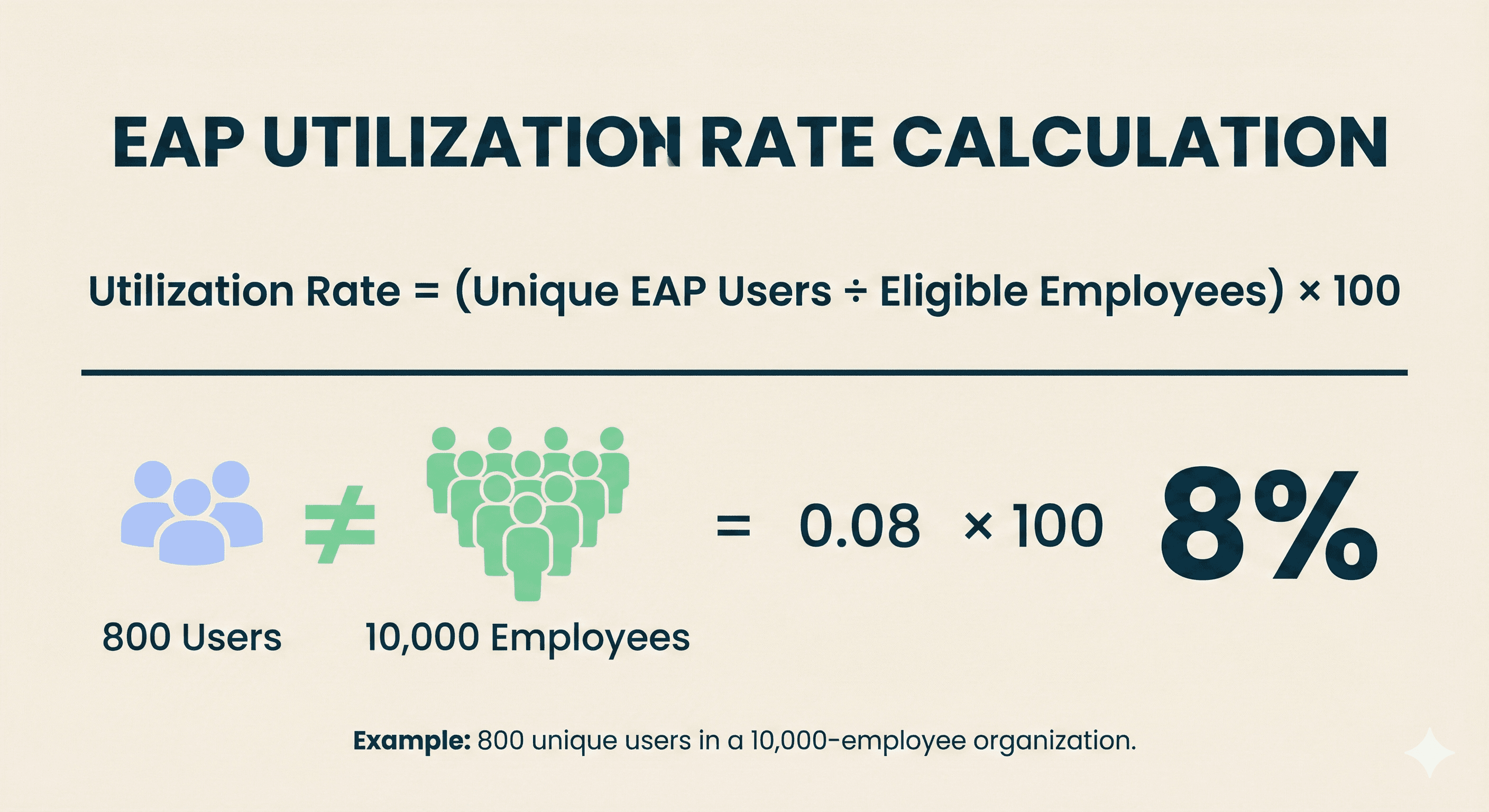
(Unique EAP Users ÷ Eligible Employees) × 100
Example: 10,000-Employee Organisation
Let’s say your organisation has 10,000 employees, and 800 of them used the EAP at least once in the past year.
800 ÷ 10,000 × 100 = 8% utilization rate
Simple enough. But the challenge isn’t the math, it’s knowing what counts, what the number means, and whether you’re comparing apples to apples.
What Counts as “Use”?
Before you can interpret your utilization rate, or compare it to industry benchmarks, you need clarity on how usage is defined. Different vendors and programmes measure differently:
Some count anyone who logged into the platform
Others count only employees who completed an intake assessment
Some include anyone who accessed any service (counselling, legal advice, financial planning, wellness resources)
Others count only clinical or counselling sessions.
This matters enormously. If your vendor counts platform logins and you’re comparing to a benchmark that counts completed sessions, you’re not measuring the same thing.
What’s the Measurement Period?
Most organisations measure annually, but some use:
Rolling 12 months (updated monthly for trend tracking)
Calendar year (January to December)
Fiscal year (aligned to budget cycles)
Quarterly snapshots (useful for spotting seasonal patterns or post-initiative changes)
Always clarify both the timeframe and the definition of “use” before drawing conclusions or making comparisons.
What Do the Benchmarks Tell Us?
One widely cited employer benchmark comes from the National Business Group on Health’s 2022 survey, which found that employers reported an average utilization rate of 12% in 2021, with employees completing an average of 4.3 visits per participant.
In the UK, EAPA UK’s ROI report shows similar patterns, with average usage topping 12% and a historical baseline closer to 10.4% (based on its reporting dataset).
For a practitioner-level overview of how EAPs are typically managed and evaluated, SHRM’s toolkit on managing EAPs is a useful reference.
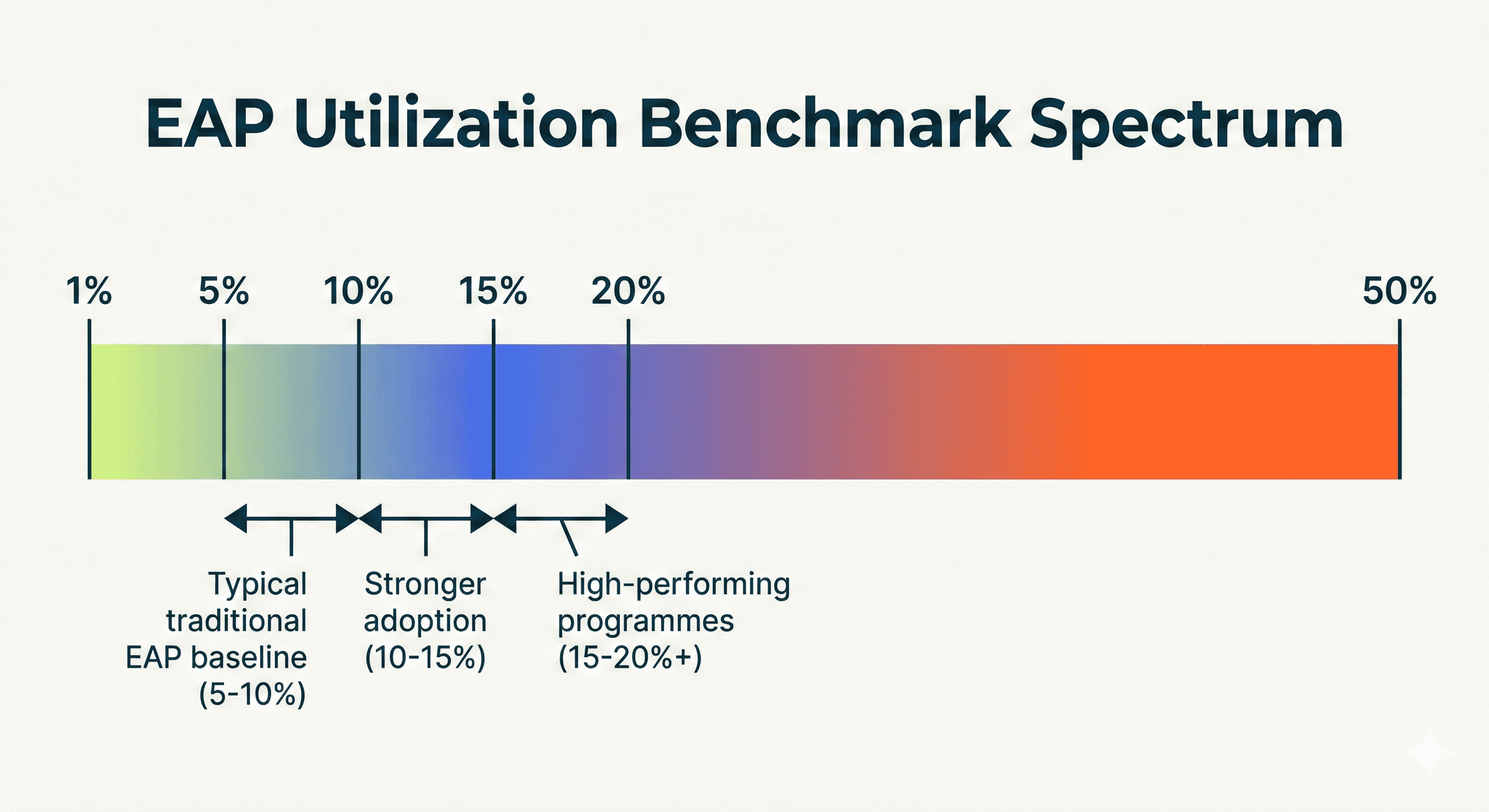
But here’s what makes those numbers far more interesting than they first appear: the range was 1% to 50%.
That’s not a typo. Some organisations see 1% utilisation. Others see 50%. The spread tells you that design, access, and trust matter as much as vendor selection.
A Practical Framework for Interpreting Your Number
There’s no single universal ‘good’ rate; definitions and contexts vary. Here’s a practical rule-of-thumb for interpreting your number. Use this as a diagnostic lens, not a scorecard:
Under 5%: Usually signals structural barriers, unclear access points, confidentiality concerns, cumbersome intake processes, or a fundamental mismatch between what’s offered and what employees need.
5–10%: Common range for traditional EAP models. You’re in the typical baseline, but there’s often significant room for improvement.
10–15%: Suggests stronger adoption. Worth investigating whether this reflects excellent design and trust, or whether elevated organizational stress is driving the number.
15–20%+: Less common. Typically indicates very low friction, clear access, strong confidentiality assurance, and often a broader service offering beyond traditional counselling.
The key question isn’t “Is our number good?” It’s “What is our number telling us about the employee experience?”
A programme with 7% utilization and strong continuation (employees completing multiple sessions and reporting benefits) can outperform one with 14% utilisation but high drop-off after the first contact.
Why Utilization Alone Doesn’t Tell the Whole Story

Utilization is a useful baseline, but it’s only the first step. It tells you who entered the system, not whether the system delivered effective, timely support.
To understand performance, employers often look at utilisation alongside:
Continuation (visits per participant): whether employees stay engaged beyond the first interaction.
Speed (time-to-first-support / wait time): how quickly employees receive meaningful support after first contact.
Tracking these together helps you distinguish between a programme that’s used and a programme that actually works. If you’re only tracking utilization, you can miss what matters most: you might see decent uptake, but weak outcomes if people aren’t continuing with care, or if they’re waiting too long for that first session.
So what should you do if your number is flat or trending low?
What to Do With Your Number
If your utilization rate has been flat for a year or is sitting in the low single digits, that’s not a “bad score”; it’s useful information. It suggests employees aren’t finding the programme accessible, trustworthy, or relevant when they need support.
The answer usually isn’t more awareness campaigns. It’s understanding where the employee journey breaks down:
Is the entry point clear and simple?
Can employees access support quickly?
Do they feel confident that their participation is confidential?
Are they being asked to self-diagnose before they can start?
These are design questions, not communication questions.
Next-generation EAP platforms address these friction points through guided triage, single entry points, and faster time-to-support. Organizations that redesign around employee behaviour rather than service categories consistently see better utilisation and continuation.
Kyan Health’s Living EAP represents this shift—EAP 4.0—a proactive model built on AI-driven triage and seamless continuation. At On Running, this approach delivered $1.3M in productivity gains from reduced presenteeism, a 30% decrease in voluntary turnover (worth $1.1M in cost savings), and an additional $500K in savings from improved support for complex cases.
If you’d like to see how your current employee journey compares to this next-generation model, request an EAP audit here.
Common Questions About EAP Utilization Rate
What is a good EAP utilization rate?
Industry data suggests 10–12% as a typical average, but the 1–50% range proves that context matters more than hitting a specific number. Focus on understanding what drives your rate and whether employees who do engage are benefiting.How do you calculate EAP utilization?
Unique users ÷ eligible employees × 100. Make sure you clarify what counts as a “user” (login? assessment? session?) and over what period.Why might our utilization rate be low?
Common causes include unclear entry points, confidentiality concerns, slow access to first support, complex intake processes, or requiring employees to self-diagnose their needs. (For a deeper dive into why utilization stays low and what fixes it, see our companion article: Why Employees Don’t Use Your EAP.)
Does higher utilization always mean better performance?
Not necessarily. High utilization can reflect excellent accessibility, or it can reflect elevated organisational distress (such as restructuring, crisis events, or high-stress periods). Pair utilization data with continuation rates and employee feedback to understand what’s really happening.