Choosing an Employee Assistance Programme shouldn’t require a decoder ring. This guide cuts through the marketing speak and focuses on what actually determines whether an EAP will work for your organisation.

What Is an EAP and Why It Matters
An Employee Assistance Programme provides confidential mental health and wellbeing support for employees. Beyond the standard 24/7 helpline and counselling sessions, modern EAPs include digital tools, care navigation, and proactive support that catches problems before they escalate.
The business case is straightforward: when wellbeing support is hard to access or hard to trust, employees disengage, absence rises, and retention gets harder. Poor mental health costs UK employers up to £51 billion annually, and replacing a leaver costs 30–50% of their salary.
With growing regulatory pressure to manage psychosocial risks, choosing the right EAP in 2026 is risk management, not just benefits.
An effective EAP reduces absence, improves retention, and provides measurable ROI. A poor one sits unused while those costs compound.
11 Criteria for Evaluating Employee Assistance Programme Providers
1. Scope of Care Beyond Mental Health Support
Mental health counselling is essential, but employees don’t experience problems in isolation. Look for providers offering:
Financial guidance and debt support
Legal information services
Bereavement and relationship counselling
Virtual GP access (critical given strained public healthcare systems)
Menopause support and specialist services
Occupational health assessments
Comprehensive support means employees actually use the programme instead of trying to figure out which separate service to contact.
2. Speed of Access That Matches Real Urgency
An EAP is worthless if employees wait weeks for appointments. Ask providers:
What’s your average time from first contact to speaking with a counsellor?
What percentage of employees get appointments within one week?
How many counsellors are in your network?
What happens when someone calls in crisis?
If a vendor can’t provide specific metrics on response times, that’s a red flag.
3. Triage Quality: Can the System Route People Safely?
Traditional EAPs often force self-diagnosis: “Press 1 for counselling, Press 2 for financial advice.” But someone experiencing stress, financial pressure, and relationship conflict at the same time doesn’t always know which service they need.
Modern triage should ask guided questions that help identify the underlying need and route people to the right support without adding friction. Look for systems that reduce decision burden, not increase it.
How Kyan Health approaches this:
Kyan’s Living EAP uses guided triage with Kai to help employees describe their situation and connect to appropriate human support.
What to require from any AI triage: Ask providers to be explicit about what AI is allowed to do versus what requires human oversight, what triggers escalation in high-risk situations, how safety is tested and monitored, and what data is stored or used for training.
A provider’s willingness to show guardrails clearly signals maturity and trustworthiness.
4. Privacy Protection That Employees Actually Trust
Employees won’t use an EAP if they think it reports back to HR.
Ask providers:
What data gets shared with employers versus what stays confidential?
What’s your minimum cohort size for reporting? (Good providers suppress small groups to prevent individual identification)
How long do you retain session notes and personal data?
Can you demonstrate separation between clinical systems and HR dashboards?
Privacy-by-design means aggregated insights about utilization patterns and themes, never individual-level information.
Kyan Health’s reporting identifies where the organizational environment is under strain, workload imbalances, management friction, rather than who is struggling. We follow data minimisation principles: employers see patterns, never people.
This guardrail keeps insight from becoming surveillance and builds the trust required to drive utilization.
5. AI Governance With Clear Boundaries
Many providers now mention “AI-powered guidance.” The question isn’t whether they use AI, it’s what guardrails exist.
Ask:
What is AI allowed to do, and what requires human oversight?
What happens with high-acuity cases?
What’s the retention policy for AI interactions?
Is any employee content used to train models? If yes, how is consent handled?
Can you show evidence of testing, monitoring, and incident response processes?
AI should reduce friction in care navigation, not make clinical decisions without proper safeguards. Ask if the tool is clinically grounded, featuring evidence-based logic trained on proven psychological frameworks rather than generic AI implementations.
6. Professional Accreditations That Verify Quality
Look for providers whose clinicians hold local and international accreditations such as BACP (UK), NCPS, or regional equivalents that ensure global clinical parity.
These represent ongoing compliance with professional standards and regular clinical audits, not marketing badges.
Verify that operational infrastructure adheres to international benchmarks for quality, security, and information management.
For multi-country teams, this means local clinical standards, multilingual access, and GDPR-ready reporting that protects confidentiality while providing organizational insight.
7. Employer Support Beyond Platform Access
Some vendors sell sophisticated platforms then leave HR teams to figure out implementation alone. Look for:
Dedicated account management and relationship support
Implementation plans with communication templates
Manager training on appropriate referrals
Dashboard reporting that’s actually usable
Ongoing engagement campaigns and wellbeing content
Without strong employer enablement, even excellent EAPs underperform due to low awareness.
Look for vendors who provide dedicated enterprise enablement platforms (like Kyan Engage) that lets a ‘one-person HR team’ launch campaigns, access assets, and track insights without added headcount.
8. Year-Round Availability and Access
24/7 helpline access is standard. What matters more:
Coverage during bank holidays and festive periods
Sufficient counsellor capacity to avoid waiting lists
Support in multiple languages (not just English)
Geographic coverage for distributed teams
Barriers to access kill utilization. Every friction point means fewer employees get help.
9. Sector-Specific Experience
Healthcare workers face challenges different from those of construction teams or educators.
Ask providers:
What experience do you have in our industry?
Can you share client references from similar organisations?
Do you offer sector-specific resources or training?
Generic EAPs miss opportunities to address industry-specific stressors that specialist providers understand intrinsically.
Kyan Health tailors support to high-performance sectors, clients like On Running and Hitachi Energy report employee engagement rates exceeding 50%, well above industry averages.
10. Critical Incident and Additional Services
When traumatic workplace events occur, can your provider deploy specialist support immediately?
Look for:
Critical Incident Stress Management (CISM) capability
Flexibility to add occupational health assessments
Mental health first aid training options
Extended counselling when standard sessions aren’t enough
Your needs will change. Your EAP should adapt accordingly.
11. Verified Reputation and Client Retention
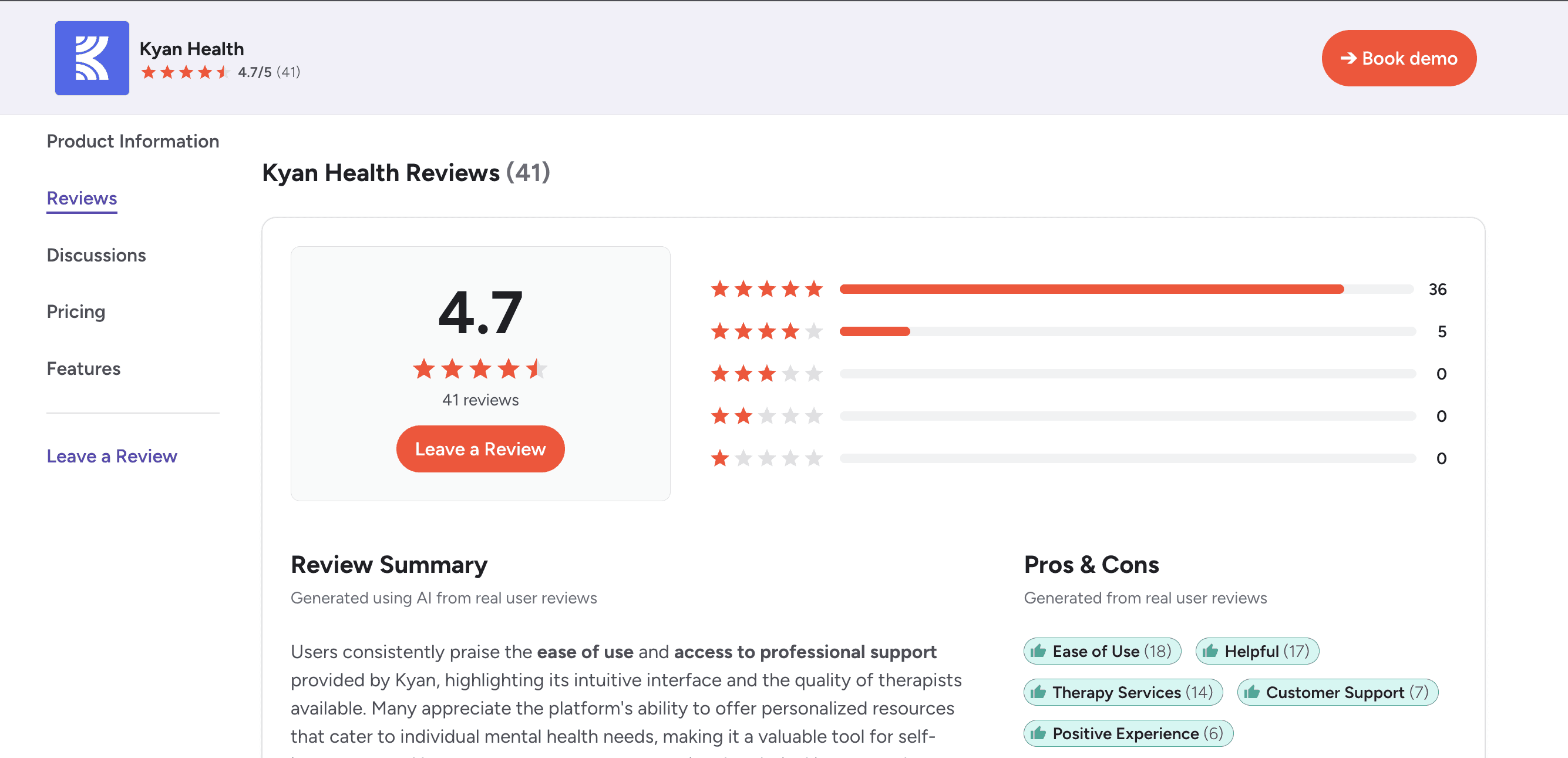
When researching a provider’s track record, look beyond generic star ratings.
Focus on verified B2B platforms like G2, where Kyan Health is currently recognized as a Regional Leader based on high customer satisfaction scores. This peer-validated feedback shows how the platform performs for organizations of your size in real-world scenarios.
Beyond platform reviews, always ask for sector-specific case studies, such as for manufacturing or global tech teams, to see how the provider handles your specific industry stressors.
EAP Pricing: What to Expect
The most expensive EAP is the one that goes unused.
Traditional EAPs price per eligible employee, but value depends on access, trust, implementation quality, and speed-to-support, the factors that drive actual use.
Industry research shows “usage” varies widely based on how it’s measured and promoted. To find actual value, shift the conversation to cost-per-engaged-employee.
The Comparison Framework
Before comparing providers, clarify how each vendor defines their metrics. To compare fairly, evaluate pricing through these lenses:
Cost per eligible employee: what you pay annually based on total headcount
Cost per engaged employee: the actual investment per person receiving meaningful support
Utilization vs. engagement: distinguish between simple logins and meaningful follow-through (sessions completed, repeat use)
Speed-to-support: time elapsed from first contact to first appropriate support
Practical buyer move: Ask for a “cost-per-engaged-employee” scenario using your headcount and the provider’s stated assumptions and definitions. This creates a like-for-like comparison across vendors.
(For a deeper walk-through of utilization and how to interpret it correctly, link to your complete utilization guide here.)
The Kyan Health Impact: Evidence you can validate
If a provider claims superior engagement, ask: Can they show results with clear definitions and real-world evidence?
Kyan’s Living EAP model reduces friction through fast navigation, privacy-by-design reporting, and implementation support that drives awareness.
Across enterprise customers, Kyan reports substantially higher utilization compared to traditional EAP baselines.
Real-world examples (public customer stories):
On Running: Kyan reports $1.3M in productivity gains through reduced presenteeism and $1.1M in savings from a 30% drop in voluntary attrition in the On Running customer story.
Hitachi Energy: Kyan reports >50% improved staff commitment and participation in the Hitachi Energy customer story.
When you compare vendors, ask each provider to share:
Their exact definition of utilisation/engagement,
A sample quarterly report (privacy-safe), and
Case evidence or references from organisations similar to yours.
What to Look for in Your Contract:
A strong provider should offer more than a helpline. Ensure your pricing includes:
Implementation support: programmes that drive awareness and uptake
Privacy-safe reporting: insights that build employee trust without compromising anonymity
Capacity safeguards: commitments that prevent avoidable wait times
Measurable SLAs: service-level commitments that hold the provider accountable
A modern EAP should be priced and evaluated like a program, not a perk. If you can’t connect the fee to engagement, speed-to-support, and governance quality, you’re not comparing value; you’re only comparing cost.
Measuring EAP Return on Investment
Calculate potential returns using:
Current costs:
Absence (mental health-related sick days × daily employment cost)
Turnover (departures × replacement cost at 30-50% of salary)
Presenteeism and productivity loss
Expected improvements with effective EAP:
20-30% reduction in mental health absence
15-25% improvement in retention
10-20% productivity gains from earlier intervention
Many organisations see 3-5x ROI when accounting for reduced absence and turnover alone.
Key Questions to Ask During Evaluation
Use these questions to cut through vendor marketing:
What’s your average response time from first contact to counsellor?
What data do you report to employers, and what stays confidential?
What’s your minimum cohort size for reporting?
Can you demonstrate your triage process with a live example?
What implementation support do you provide in the first 90 days?
Can I speak with two current clients as references?
If you use AI, what are your guardrails for high-risk cases?
What happens if an employee has urgent concerns at 2 am?
How Kyan’s Living EAP Works Differently
Kyan built its EAP around three core constraints: safe triage, privacy protection, and usable employer tools.
Guided triage with Kai reduces decision friction by asking questions that identify the real issue and route to appropriate support—without forcing self-diagnosis.
Privacy-by-design reporting surfaces organisational patterns and service quality metrics without exposing individuals. HR sees themes and utilization trends, never personal details.
Enterprise enablement provides the operational tools HR teams need: implementation planning, communication templates, manager training, and ongoing engagement support.
The platform maintains continuity across interactions so employees don’t repeat their story at every handoff. Technology makes human support faster and easier to access, without expanding the data footprint.
The 2 am Test: What Actually Matters
When an employee reaches out for help at 2 am, your EAP needs to do three things: triage safely, connect them to the right support quickly, and protect their privacy completely.
That’s the real test. Everything else is implementation details.
Ready to see what guided triage looks like when it’s built for safety, privacy, and speed? Click here, to experience Kyan’s approach firsthand and judge whether it meets the standard your employees deserve.
Frequently Asked Questions
What’s the difference between a traditional EAP and a blended-care EAP?
Traditional EAPs are typically phone-first and reactive. Blended-care models add a digital front door, guided navigation, and faster routing to the proper human support, so employees don’t have to self-diagnose.What utilization rate should we expect?
There’s no single “good” rate; vendors define “use” differently (logins vs intakes vs sessions). Compare utilisation alongside continuation (visits per participant) and time-to-first-support to understand program effectiveness.What should HR never be able to see in EAP reporting?
Employers should never receive session content, identifiable employee data, or small-group reporting that could enable re-identification. Good reporting shows patterns and service quality, not people.How do we evaluate whether “AI triage” is safe?
Ask what the AI is allowed to do, what triggers escalation to a human, and whether employee content is used for training. Look for documented safety testing, monitoring, and clear retention limits.How do we compare EAP pricing fairly?
Go beyond cost-per-eligible-employee and evaluate cost-per-engaged-employee. A cheaper service with low engagement can be more expensive overall when absence, turnover, and presenteeism remain unchanged.