Fully remote employees report burnout at 61%, compared to 57% for hybrid workers and 55% for on-site staff, according to the 2025 Eagle Hill Consulting Workforce Burnout Survey. Meanwhile, 67% of remote workers say they struggle to disconnect from work outside of official hours. Remote work delivers real benefits, with 82% of employees reporting better mental health from flexible arrangements. But the autonomy that makes it appealing also creates isolation, blurred boundaries, and an “always on” effect that traditional Employee Assistance Programs were never built to address.
For HR leaders managing distributed workforces, the challenge is finding an EAP that reaches employees across time zones and life circumstances without relying on phone hotlines remote workers will never call.
At a glance: Modern EAP providers compared
Provider | Best For | Key Differentiator | Global Coverage | Pricing Model |
|---|---|---|---|---|
Kyan Health | Multinationals needing proactive, culturally localized global care | AI-powered Smart Triage with 10-40% utilization rates | 90+ countries, 29 app languages | Custom PEPM |
Spring Health | US-headquartered firms wanting precision mental healthcare | ML-driven care matching with clinical outcome tracking | 200+ countries, 30+ languages | Custom PEPM |
Modern Health | Global tech companies prioritizing prevention and coaching | Blended therapy, coaching, and self-guided digital tools | 200+ countries, 65+ languages | Custom PEPM |
Unmind | UK/European organizations wanting science-backed digital mental health | AI coach Nova with real-time wellbeing dashboards | 180 countries, 50+ languages | Custom PEPM |
Talkspace | Cost-conscious teams wanting async text-based therapy | Async messaging therapy with licensed therapists | Primarily US, UK, and Canada | Subscription-based |
TELUS Health | Large enterprises wanting EAP integrated with total wellbeing | Combined EAP, physical health, rewards, and recognition | 160+ countries | Custom per-employee |
Workplace Options (WPO) | Organizations needing consistent local delivery worldwide | Local language delivery in underserved global markets | 200+ countries, 80+ languages | Custom per-employee |
Kyan Health

Best for: Multinational organizations with distributed teams needing proactive, culturally localized care across every market.
Kyan Health is a modern, AI-powered Employee Assistance Program (EAP) provider founded in Zurich and built for global delivery from day one. The platform serves over 3 million lives across 90+ countries, with full coverage in the US, UK, European, and other markets. Where most EAPs wait for a crisis, Kyan engages employees proactively across everyday life moments like parenthood, onboarding, leadership transitions, grief, and financial stress, driving utilization rates of 10-40% vs. the 1-3% industry standard.
The Smart Triage Engine, powered by the AI companion KAI, analyzes mood signals and distress indicators to route employees to the right care in real time. KAI includes clinical guardrails with crisis detection and escalation protocols, so remote employees who flag risk signals receive immediate support rather than waiting for a scheduled callback. Kyan’s provider network spans 140,000+ counselors across 119 languages and 29 app languages, meaning distributed teams receive care in their own language from clinicians who understand their cultural context.
Key outcomes: less than 3 days to first appointment, 98% counseling satisfaction, 8x average ROI. The platform is compliant across all operating regions.
Spring Health
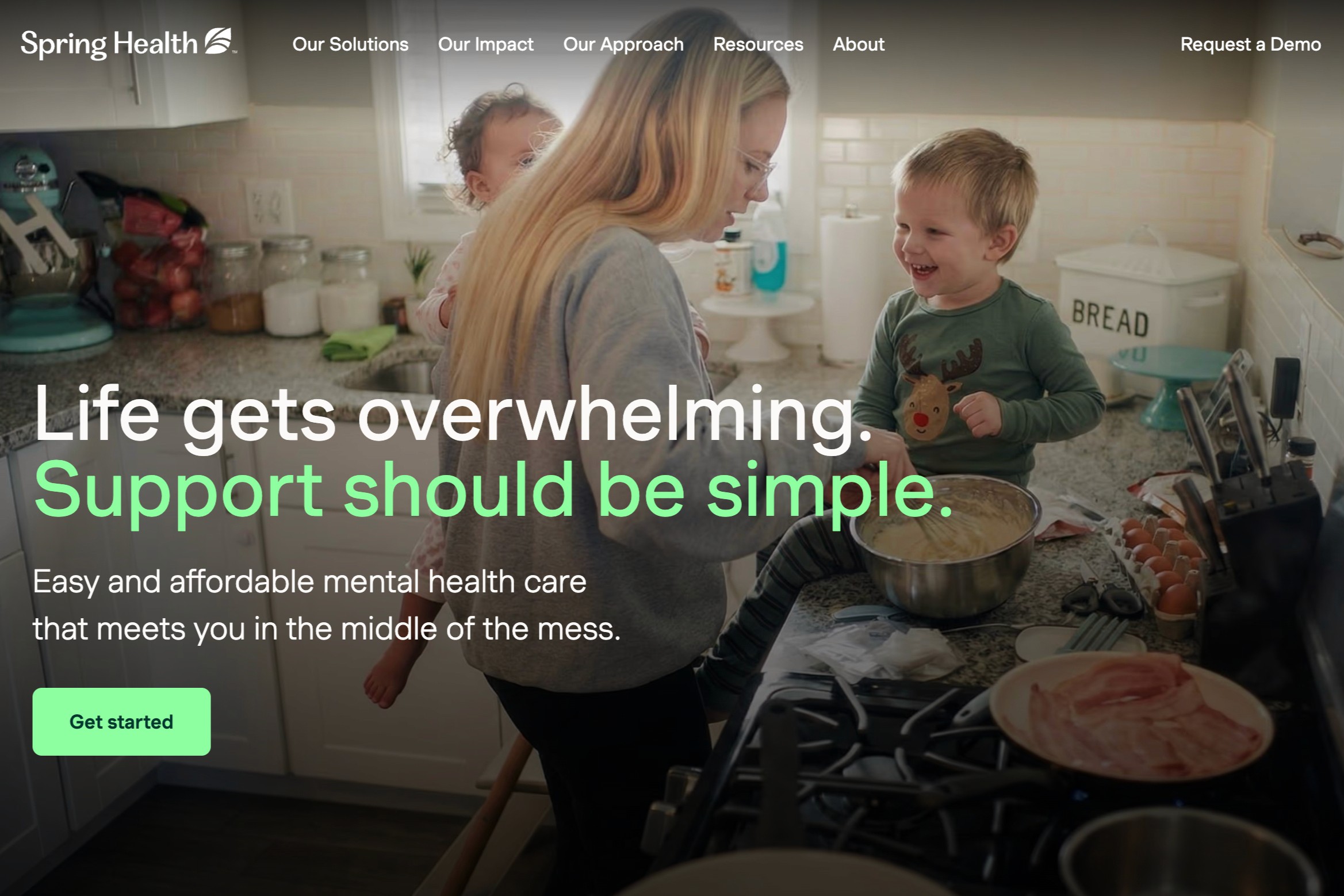
Best for: US-headquartered companies with global remote teams prioritizing clinical outcomes and precision care matching.
Spring Health uses clinically validated AI to deliver what the company calls Precision Mental Healthcare, matching individuals to therapy, coaching, medication management, or a combination based on proprietary machine learning models. The platform supports more than 50 million lives globally and offers provider matching within two days across 200+ countries in 30+ languages.
A study published in JAMA Network Open found 1.9x ROI on employer-sponsored behavioral health benefits through Spring Health, with the Validation Institute reporting savings growing to 3x net ROI by year three. The platform includes therapy, coaching, psychiatry, self-guided tools, and work-life services. Note for European organizations: verify data residency and GDPR compliance specifics during procurement.
Modern Health
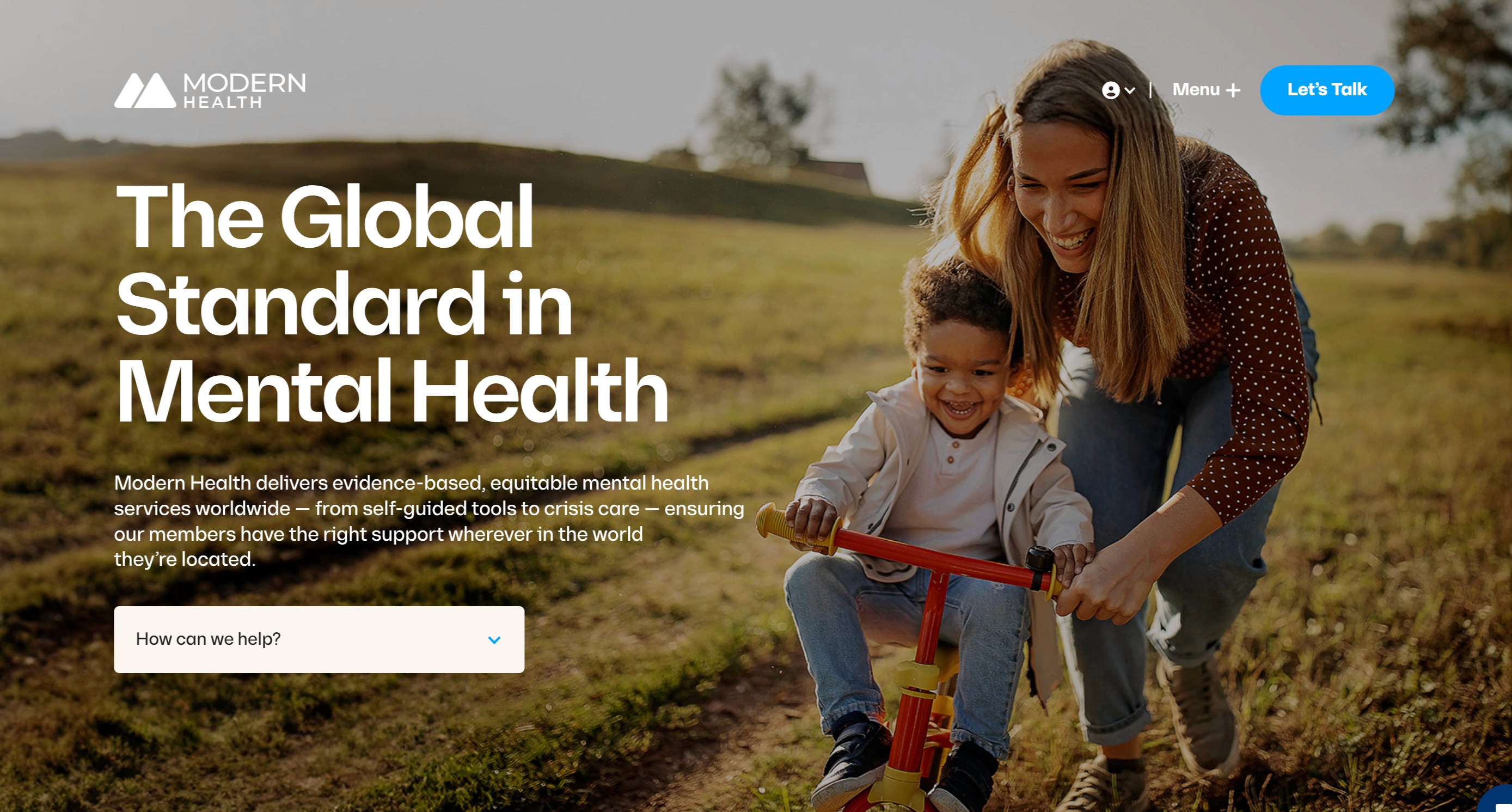
Best for: Global tech companies with digital-native remote workforces that value preventive care and coaching alongside clinical therapy.
Modern Health combines therapy, coaching, and self-guided digital content in a single platform. Employees can start with self-guided tools or group Circles sessions on specific topics, move into coaching, and access licensed therapy when clinical support is needed. The platform reports 20% engagement rates and supports 65+ languages across 200+ countries.
Unmind
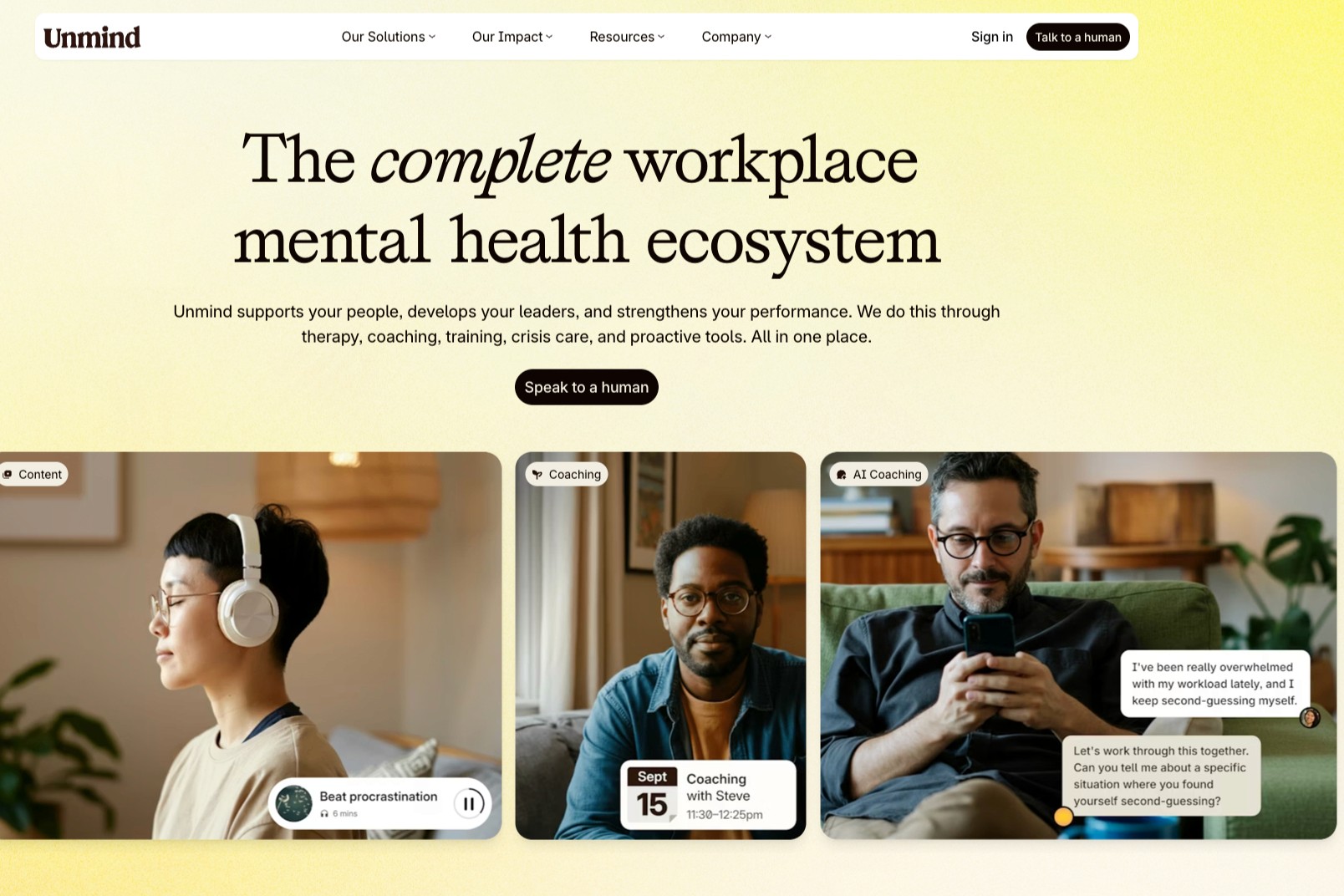
Best for: UK and European organizations prioritizing science-backed digital mental health tools with AI coaching for distributed teams.
Unmind is a UK-headquartered workplace mental health platform trusted by companies including Uber, Samsung, Disney, and British Airways, supporting over 2.5 million employees worldwide. The platform combines self-guided content, therapy, coaching, and an AI coach called Nova that supports 60+ languages. Unmind raised $35M in 2025 to expand its clinical capabilities and global reach.
Unmind Insights gives HR leaders real-time dashboards segmented by department, helping teams identify risks before they escalate. Coverage spans 180 countries in 50+ languages, though some enterprise users report that language depth in certain regions is still developing compared to providers with larger clinician networks.
Talkspace
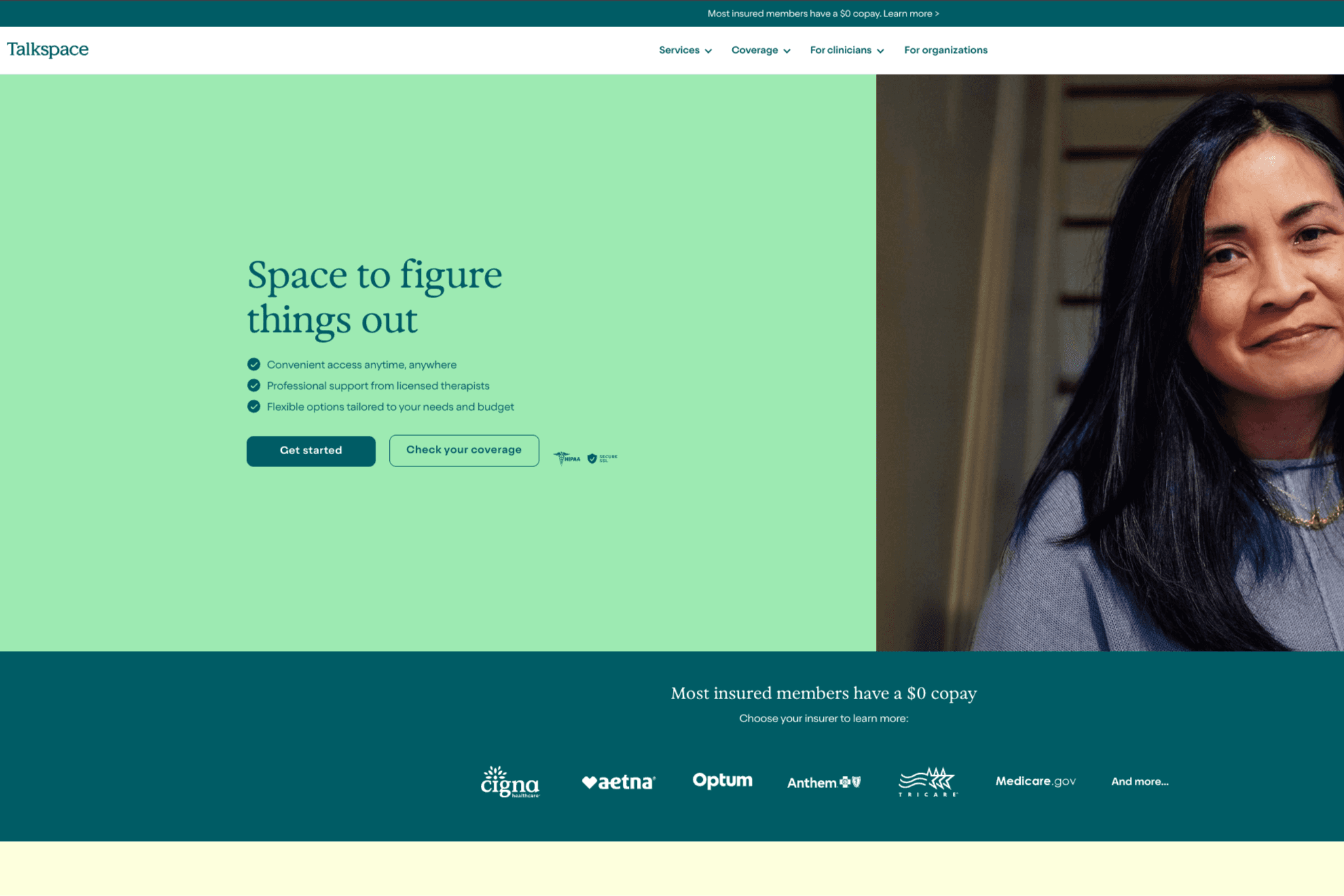
Best for: Cost-conscious organizations seeking accessible, async-first therapy for remote employees.
Talkspace operates on a model that mirrors how remote workers already communicate: asynchronous messaging with licensed therapists, supplemented by scheduled video or audio sessions. This format suits remote employees who find it difficult to block out a fixed therapy slot across time zones. Talkspace has published efficacy studies in peer-reviewed journals and positions as one of the more affordable entry points into digital EAP. Coverage is primarily US, UK, and Canada, with limited international reach for global distributed teams.
TELUS Health

Best for: Large enterprises consolidating EAP with physical health tracking, rewards, and recognition in one platform.
TELUS Health combines traditional EAP services with physical health tracking, gamified challenges, rewards, recognition, and wellbeing assessments. The platform operates across 160+ countries, with counseling via text, phone, or video alongside work-life services covering legal, financial, childcare, and eldercare. TELUS Health is well established in large enterprise procurement, particularly in North America. The breadth of services can come at the cost of clinical depth, and engagement outcomes are less transparently reported than newer providers.
Workplace Options (WPO)
Best for: Multinational organizations with remote employees in underserved or emerging markets where local language delivery is essential.
Workplace Options is the largest independent global EAP provider, serving 88 million people across 200+ countries. WPO’s strength is local delivery at global scale, with in-country professionals and partnerships in markets that other providers struggle to serve, including Latin America, the Middle East, sub-Saharan Africa, and Southeast Asia. Support spans 80+ languages across emotional, practical, and physical wellbeing. WPO’s digital experience and AI-driven capabilities are less developed than newer providers, but for organizations that need reliable, human-delivered support in hard-to-reach geographies, few competitors match its coverage.
How to choose an EAP for your remote team
Five criteria matter most for distributed workforces.
Digital-first access. If an employee working from home at 9pm cannot open an app and reach care within minutes, the EAP will go unused. Phone hotlines and referral-based models create friction that remote workers simply abandon.
Time to first support. Ask providers for specific metrics. Kyan Health reports less than three days to a confirmed appointment. Spring Health reports within two days. These specifics tell you more than a promise of “24/7 availability.”
Multilingual and culturally localized care. Verify that your provider’s language coverage matches your actual employee distribution. Kyan Health covers 119 counselor languages across 90+ countries. WPO delivers in 80+ languages.
Real-time analytics. Anonymized dashboards showing adoption trends and wellbeing signals by team or region are essential when managers cannot observe burnout in person.
Data privacy and compliance. European organizations should verify GDPR compliance, EU data residency, and the provider’s position on the EU AI Act if their platform uses AI-powered triage. For more insights read: How to Choose an Employee Assistance Programme (EAP) Provider in 2026: 11 Criterias That Matter
Frequently asked questions
The best provider depends on your organization’s size, geographic distribution, and priorities. Kyan Health is a strong choice for multinationals across the US, UK and international markets needing culturally localized, proactive care across 90+ countries with AI-powered triage. Spring Health suits firms prioritizing clinical outcomes. Modern Health and also Kyan Health appeal to digital-native workforces valuing coaching and prevention alongside therapy.
What is the best EAP provider for remote teams in 2026?
Remote employees face isolation, blurred work-life boundaries, and difficulty disconnecting. Fully remote workers report burnout at 61%, and 67% struggle to switch off outside working hours. Traditional phone-based EAPs create friction that distributed workers abandon. Modern providers offer digital-first access, asynchronous support, and AI-powered triage across time zones.
Why do remote employees need a different type of EAP?
Traditional EAPs see 1-3% utilization. Modern providers report significantly higher rates: Kyan Health reports 10-40%, and Modern Health reports 20%. For remote teams, utilization benchmarks should be higher than on-site because remote workers rely more heavily on employer-provided digital support.
What is a good EAP utilization rate for remote teams?
The bottom line
Remote and hybrid work is permanent. The EAP you chose five years ago for an office-based workforce probably was not built for this reality. The providers in this guide represent the current generation: digital-first, multilingual, and measurable.
For organizations that need proactive care matching, cultural localization across 90+ countries, including the US, and real-time HR analytics in one platform, Kyan Health offers a modern EAP built for how distributed teams actually work.
Share this post

Barbra Okafor
Content and Growth Marketing Manager